
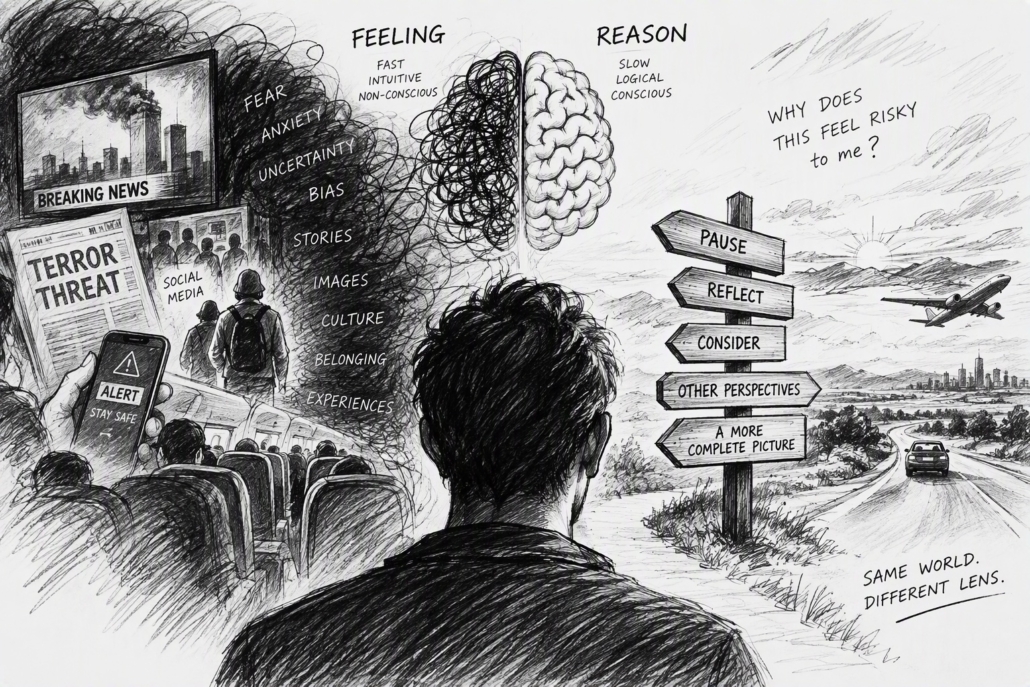
Why Does Risk Feel the Way It Does?
Risk isn’t just something we calculate or manage; it’s something we experience, interpret, and feel.
We often speak of risk as though it can be clearly calculated, assessed and managed. We develop matrices, controls, procedures and frameworks to make uncertainty more manageable. These tools have their place. Yet I wonder whether they sometimes draw our attention away from something more human.
We may sense risk before we (consciously) think about it, often without even realising it.
Fear, anxiety, hope, trust, familiarity, uncertainty, and even our sense of belonging (or not belonging) can shape how risky something feels, often before we have consciously considered the evidence. Because these responses operate partly outside our conscious awareness, we can easily mistake our judgements for objective descriptions of the world.
This is not an argument against evidence, analysis or disciplined decision-making. It is an invitation to notice that analysis never arrives alone. We bring our histories, relationships, cultures and expectations with us when making sense of risk.
Risk may have objective features, but our encounter with it is also subjective and social.
Risk begins in experience
I recognise this in my own life. As a child, I was afraid of the dark. That fear haunted me for years and kept me from doing things that, rationally, posed little danger. Knowing there was probably nothing hiding in the darkness did not make the feeling go away. The darkness felt unsafe, and in that moment the feeling mattered more than the evidence suggested.
I still notice versions of this today. Consider driving on an unfamiliar road at night. The road may be no more dangerous than the one I travel regularly, yet unfamiliarity changes how it feels. A bend seems sharper, the darkness more threatening, and uncertainty about what lies ahead makes me more cautious. Put me on a familiar road in similar conditions, and I may experience the risk quite differently.
That is what interests me most about risk. We do not encounter it as blank slates. Previous experiences, memories, assumptions, relationships and feelings shape what we notice and how we interpret it. Familiarity can make something feel safer. Uncertainty can make it feel more threatening. Trust can change our willingness to take a chance. Fear can make a possibility seem more probable because it is vivid and readily available to us.
The affect heuristic: when feeling guides judgement
Paul Slovic’s work on the affect heuristic gives language to this experience. Slovic describes how our overall feeling about an activity can act as a rapid cue for judging both its risks and its benefits:
“The earliest studies of risk perception also found that, whereas risk and benefit tend to be positively correlated in the world, they are negatively correlated in people’s minds… If their feelings toward an activity are favorable, they are moved toward judging the risks as low and the benefits as high; if their feelings towards it are unfavorable, they tend to judge the opposite – high risk and low benefit.”
Slovic (2010, p. 26)
This helps explain why people can experience the same activity so differently. A favourable feeling does more than accompany our assessment; it may shape the assessment itself. Benefits become easier to see, while risks recede. When our feeling turns unfavourable, the relationship can reverse: possible harms become vivid, while benefits are discounted.
The affect heuristic is not simply a defect to be corrected. Fast, feeling-based judgement enables us to navigate a complex world without calculating every possible consequence. As with all biases, it can be protective and efficient. But it can also narrow what we notice. The task is therefore not to eliminate feeling. It is to become more curious about how feeling is participating in judgement.
A Lamborghini, a waiver and a changing sense of risk
A drive in a Lamborghini brought this home to me.
I’ve loved cars since childhood, particularly fast ones, and a one-hour drive in a hired ‘lambo’ felt like a near-perfect gift from my wife. In the months beforehand, my best mate and I talked about how much fun it would be. We arrived feeling very positive about the activity. At that point, the benefits were immediate and vivid; the risks barely registered. This was going to be fun!
Then the context shifted. After the breath test, induction and paperwork and a series of lectures, I was reminded that the car had cost around $500,000 when new, was in pristine condition and had not been involved in an accident during the life of the (hire) business. I was then asked to accept responsibility for a $10,000 insurance excess if I were at fault.
The car had not changed, but the meaning of the drive had. I was about to operate an unfamiliar vehicle capable of accelerating from 0 to 100 km/h in 3.8 seconds, and a mistake could have an immediate and substantial financial consequence. My feeling shifted, and the risk suddenly seemed greater.
For the first 15 or 20 minutes, I drove cautiously. I took time to develop a feel for the car and asked my passenger to help check before I changed lanes. As familiarity grew, tension eased. The engine, the responsiveness and the shared experience became salient again. Halfway through the drive, the $10,000 excess had largely receded from awareness. The benefit felt vivid once more, and the perceived risk softened.
This is the important point: my assessment did not remain fixed. Feeling, attention, familiarity and behaviour moved together. When concern was prominent, I drove conservatively. As comfort and enjoyment grew, the potential financial consequence became less psychologically available. The formal risk conditions had not disappeared, but my lived experience of them had changed.
Risk is not only something we think about
Daniel Gardner, in The Science of Fear, draws on Daniel Kahneman’s two-system understanding of judgement. Gardner writes:
“Every human brain has not one, but two systems of thought. They called them Systems One and System Two. The ancient Greeks arrived at this conception of humanity a little earlier than scientists – personified the two systems in the form of gods Dionysus and Apollo. We know them better as Feeling and Reason.”
The distinction matters. We like to imagine that judgement begins when we deliberately gather information, weigh probabilities, consider consequences and decide. Often, however, intuitive, largely non-conscious sensemaking is already underway. Stories, images, language, relationships, culture and social arrangements shape what feels safe, threatening, familiar or uncertain. By the time conscious reasoning arrives, the story may already have begun.
This does not make us irrational. It makes us human. It also means that understanding risk requires more than grasping probability. We need to remain curious about the social, cultural, relational, and psychological ways people experience uncertainty.
When feeling and probability part ways
A confronting example comes from Gerd Gigerenzer’s research on behaviour after the terrorist attacks of September 2001. Gigerenzer reported that air travel declined, interstate highway travel increased, and fatal highway crashes exceeded the previous year’s baseline the following year. He estimated that 1,500 Americans died on the road while seeking to avoid the fate of passengers on the four fatal flights.
From a distance, the contradiction seems plain. But distance itself is a kind of privilege. For those living among the images, stories, grief, and uncertainty of that time, risk was never merely something to calculate. Flying felt dangerous, and the fear of one threat shaped people’s choices in ways that made them vulnerable to another.
This is not evidence that feelings are irrelevant. It is evidence that feelings can be consequential. They shape what becomes salient, what we avoid and what we accept in its place.
Fear can alter what we perceive
The relationship between feeling and perception can reach beyond abstract judgement. Research by Tali Leibovich, Noga Cohen and Avishai Henik examined whether fear of spiders influenced estimates of their size. Participants with both high and low fear rated spiders as unpleasant, but only the highly fearful participants overestimated spider size relative to neutral animals.
As the researchers put it:
“We found that although individuals with both high and low arachnophobia rated spiders as highly unpleasant, only the highly fearful participants overestimated the spider size.”
The finding is striking because it suggests that emotion can shape how we perceive even a basic feature like size. A fearful participant is not necessarily choosing to exaggerate; rather, attention, relevance, and feeling shape how the world is experienced, making the spider seem larger.
I recognise the point. I dislike spiders (a lot!). When I see one, a response arises before deliberate thought. I know I am larger, that most spiders will not jump, and that I have more control over the situation, yet the body does not wait for a rational briefing. The feeling is already present, organising attention and action.
We do not encounter risk as blank slates
The same dynamic can occur socially. On an international flight not long after 9/11, I noticed two men seated a few rows ahead of me, and an association surfaced in my mind: they ‘looked like terrorists’. I had not carefully assessed the evidence. My mind had been exposed to repeated images, stories and cultural associations, and in an uncertain moment, that pattern became available.
I am not proud of the judgement. Yet pretending it could never happen again would teach me less than becoming curious about how it happened. Reflection doesn’t prove our innocence. It can help us notice how social narratives become embodied as apparently immediate perceptions.
Our judgements are never entirely detached from who we are, what we have experienced, the groups to which we belong, the stories circulating around us and the emotions those stories evoke. What one person experiences as threatening, another may barely notice. What appears unacceptable to one community may feel ordinary to another. Risk therefore has objective dimensions, but the human experience of it is deeply subjective, relational and social.
Curiosity before certainty
Awareness does not make us immune to affect, bias or unconscious judgement. Knowing about heuristics does not turn us into perfectly rational decision-makers. Even Daniel Kahneman, in talking about his research on cognitive biases, said he was not immune to their effects.
Perhaps a more useful response is humility.
When something feels dangerous, threatening or unacceptable, we might pause before assuming the feeling tells us everything there is to know. We might ask:
- What am I noticing?
- What am I feeling?
- Where might that feeling have come from?
- What experiences, relationships, images or stories may be shaping my judgement?
- What has become vivid, and what may have faded from view?
- What might someone else be seeing or feeling that I am not?
These questions do not replace analysis. They deepen it. They invite Feeling and Reason into conversation rather than pretending that one can be removed from the other.
The practical implication is not that every felt concern is mistaken or that every risk is merely subjective. It is that how risk feels influences what we notice, how we interpret evidence and how we behave. If we want wiser conversations about uncertainty, we need methods that take both the measurable features of a situation and the lived experience of those involved seriously.
Perhaps the question is therefore not simply, How risky is this?
It might also be: Why does this feel risky to me?
Sitting quietly with that question may tell us as much about ourselves, our relationships and the stories around us as it does about the risk in front of us.
References
Finucane, M. L., Alhakami, A., Slovic, P., & Johnson, S. M. (2000). The affect heuristic in judgments of risks and benefits. Journal of Behavioral Decision Making, 13(1), 1–17.
Gardner, D. (2008). The science of fear: Why we fear the things we shouldn’t – and put ourselves in greater danger. Dutton.
Gigerenzer, G. (2004). Dread risk, September 11, and fatal traffic accidents. Psychological Science, 15(4), 286–287.
Leibovich, T., Cohen, N., & Henik, A. (2016). Itsy bitsy spider? Valence and self-relevance predict size estimation. Biological Psychology, 114, 138–145.
Slovic, P. (2010). The feeling of risk: New perspectives on risk perception. Earthscan.
| ROBERT SAMS Author, Social Sensemaking robert@dolphyn.com.au | www.dolphyn.com.au |

Leave a Reply
Want to join the discussion?Feel free to contribute!