
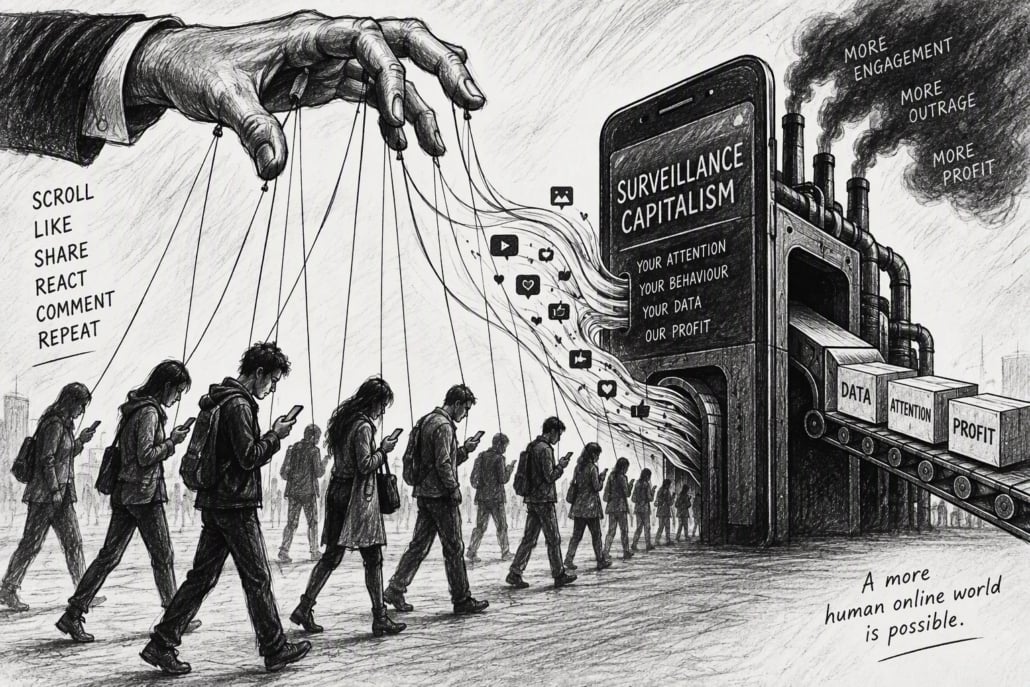
Our Attention Is the Product
Like many Australians, I have been unsettled by the alleged attack on independent MP Helen Haines outside her electorate office in Wangaratta.
At the time of writing, the circumstances and possible motivation remain under investigation. It would therefore be irresponsible to draw a direct line between anything a person may have posted or consumed online and this act of violence.
Still, the attack has prompted reflection on the rising temperature of Australian public life. Commentary from the ABC and The Guardian has raised concerns about political polarisation, personal vilification, and social media’s capacity to amplify hostility.
This invites a broader question:
What kind of world are our digital systems encouraging us to inhabit?
Our attention is the product….
When discussing social media, we often focus on individual responsibility, especially as a remedy offered to those who experience challenges with it.
We advise people to spend less time online, check sources, block abusive accounts or simply put the phone down. There is wisdom in this and I am certainly not immune from the pull of the screen or the temptation to respond too quickly.
But what if this is not simply a problem of poor individual choices?
What if social media is working largely as designed?
Most platforms appear free, yet they operate by capturing our attention and gathering information about our behaviour. They learn what causes us to pause, click, share, fear or become angry. That knowledge helps predict what will keep us engaged.
This is part of what has become known as surveillance capitalism, where human experience is converted into data, prediction and profit.
Our attention is not incidental to the business model. It is the resource being extracted.
Fracking our attention
At SXSW Sydney, author Johann Hari described social media algorithms as machines “designed to frack your attention”.
The metaphor feels apt.
Our attention is drawn out in fragments: a notification, a provocative headline, a comment that angers us, or an argument that keeps us online longer than intended.
If our attention is continually being fractured, what happens to our capacity to attend to one another?
Listening takes patience. Compassion requires imagination. Dialogue asks us to remain present long enough to encounter another person as more than a position, label or threat.
These qualities are difficult to cultivate within systems built around speed, interruption and reaction.
If it is enraging, it is engaging
Social media algorithms do not need to hate anyone. They need engagement.
A platform can measure views, replies, shares and time spent online. It cannot easily distinguish between attention given to something meaningful and attention captured by something frightening or enraging.
From the perspective of the metric, attention is attention.
Research reported by Stanford Report found that engagement-based feeds could surface material conflicting with users’ stated values because people often engage with content they oppose. The algorithm may interpret outrage as interest and provide more of the same.
This creates a troubling incentive:
Rage keeps us engaged, and engagement can be converted into revenue.
Compassion tends to work differently. It asks us to slow down, listen and suspend judgement. Kindness does not always produce a spectacular headline. Humility rarely goes viral. Nuance is difficult to sustain in systems rewarding immediacy and certainty.
This is not to suggest anger is wrong. Anger can alert us to injustice and animate collective action. The concern is that commercial systems may provoke, prolong and amplify anger because it is profitable.
From people to symbols
Polarised discourse also makes it easier for people to disappear behind categories.
Politician. Progressive. Conservative. Activist. Elite. Left. Right.
Once someone has been reduced to a label, we no longer encounter a complex and fallible person. We encounter a symbol onto which we can project our fear, frustration or contempt.
Dehumanisation does not begin with violence. It begins when curiosity collapses. It grows when humiliation becomes entertainment and cruelty is mistaken for courage.
Social media did not create tribalism, scapegoating or hatred. But it can industrialise them, making contempt repeatable, measurable and profitable.
What are we becoming?
I do not think the answer is simply to leave social media.
These platforms can create connection, organise support and expose injustice. They contain much that is generous and hopeful because people remain capable of generosity and hope.
The deeper task is to examine the systems beneath our participation.
The attack on Helen Haines should not become an opportunity for premature conclusions or political point-scoring. It should first call us towards care for her, those who love her, her colleagues and her community.
But care need not prevent critical reflection. Perhaps genuine care requires it.
If we want a democracy in which people can disagree without dehumanising one another, we may need to ask whether platforms designed to monetise engagement can protect the relational conditions upon which democracy depends.
Some questions to sit with
- What happens when the systems mediating public conversation profit more from outrage than understanding?
- How might we distinguish what genuinely matters to us from what an algorithm has learned will capture us?
- How might we create spaces that value curiosity, compassion and disagreement without dehumanisation?

Leave a Reply
Want to join the discussion?Feel free to contribute!