
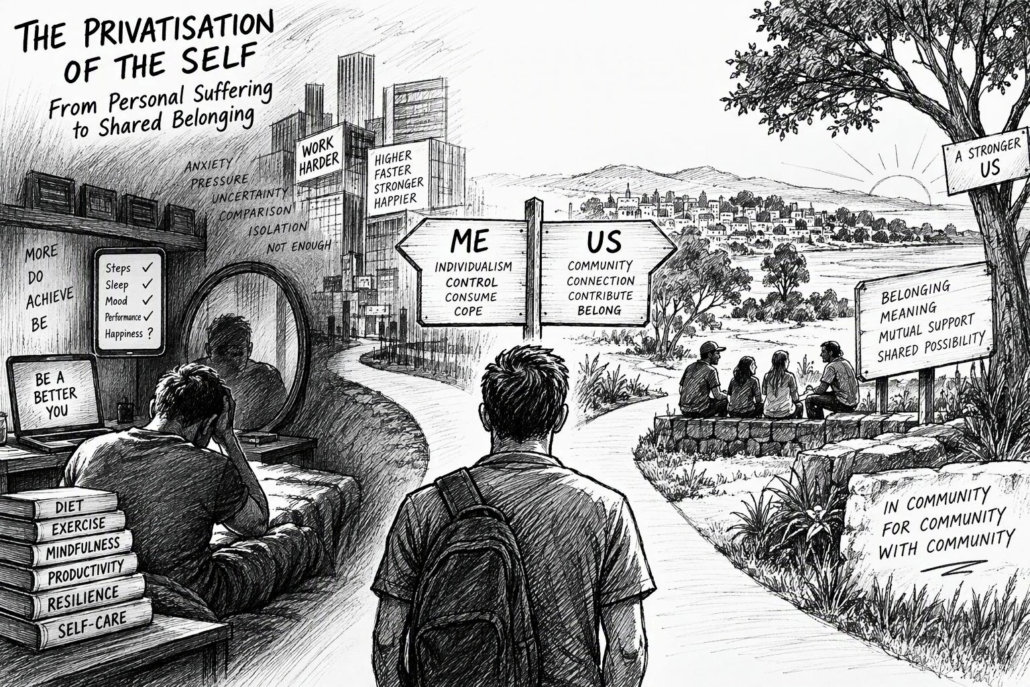
The Privatisation of the Self: From Personal Suffering to Shared Belonging
We are encouraged to treat suffering as a private problem, but what if healing begins when we look beyond the self and rediscover the possibility of us?”
When I’m unwell, I may visit a doctor, describe what is happening, listen to the questions, and consider the recommended treatment. Sometimes that treatment includes medication, and I may take it because medical knowledge matters and because seeking help can be an act of courage rather than weakness. Yet I also want to think critically. I want to understand what I am taking, why it has been recommended, what effects it might have, and what other possibilities should be considered. I want to be a participant in decisions about my health rather than a passive recipient.
This is not a choice between trust and doubt. I can respect a clinician’s expertise while recognising that medicine operates within cultural, institutional and commercial systems. I can accept treatment without believing treatment explains the whole of my experience. Perhaps the important question is not whether I should trust or question, but how I might do both without allowing either unquestioning compliance or permanent suspicion to take over.
Can I accept help without surrendering my agency and without imagining that I stand outside the relationships and systems that make help possible?
When the problem is located within us
Our world is deeply shaped by individualism. Success and failure, health and illness, resilience and distress are often presented as personal achievements or personal deficiencies. If I am exhausted, perhaps I need stronger boundaries. If I am anxious, perhaps I need to regulate my thoughts more effectively. If I feel overwhelmed, perhaps I need a better morning routine, more exercise, improved sleep or a mindfulness app. Any of these practices may help, and there is no virtue in dismissing something simply because it focuses on the individual.
The difficulty begins when the individual becomes the only available unit of explanation. Exhaustion may arise not only from poor self-management but also from insecure work, unmanageable expectations, debt, loneliness, technological saturation or the continual demand to perform. Anxiety may be experienced privately while being shaped socially. The world does not merely surround us; it enters our language, bodies, relationships and sense of what is possible. We make choices, but we make them within conditions we did not choose.
What might change if, before asking what is wrong with a person, we also asked what has been happening around, between and to them?
The privatisation of distress
In Capitalist Realism, Mark Fisher challenges the tendency to interpret mental distress entirely through individual psychology and personal responsibility. Depression, anxiety and exhaustion do not arise in a social vacuum. Precarious employment, competition, debt, workplace pressure and the erosion of collective security may all contribute, yet the resulting distress is commonly returned to the individual as a private problem requiring private adjustment.
The workplace remains unchanged, but the worker is offered resilience training. The workload remains unreasonable, but the person is encouraged to become more mindful. The system contributes to exhaustion and then offers techniques for adapting more successfully to it. This does not make resilience or mindfulness worthless. The paradox is that useful practices can support people while also diverting attention from the conditions making those practices necessary.
Even when the conditions are unjust, however, I still have to live within them. Structural critique may explain why I am struggling, but it may not help me sleep tonight, restore a strained relationship or make tomorrow manageable. I may still need counselling, medication, rest or a change within my immediate influence. Recognising the system does not remove the self, just as caring for the self does not absolve the system.
How might we care for ourselves without turning every social wound into a private failure, and how might we challenge harmful conditions without postponing the care that is needed now?
When wellness becomes another demand
Carl Cederström and André Spicer deepen this concern in The Wellness Syndrome. They examine how the pursuit of health and happiness can become a moral command, so that feeling well becomes difficult to separate from being good. We count steps, monitor sleep, optimise routines and track progress. Even rest can become another performance measure. There is nothing inherently wrong with wanting to be well, but something shifts when wellness becomes compulsory, and illness begins to look like a failure of discipline or character.
Sarah Taylor’s The Wellbeing Paradox raises a related challenge in organisational life. Wellbeing can become a program, metric or intervention while the ordinary conditions of work remain largely untouched. An organisation may provide yoga, a seminar or an employee assistance program while avoiding harder questions about workload, autonomy, insecurity, recognition and belonging. The employee is asked to become more resilient, perhaps because changing the individual appears easier than changing the organisation.
Here again, the tension should not be resolved too quickly. Exercise, sleep, nutrition, medication and mindfulness are genuinely helpful. The concern is not that personal practices are false, but that they may be asked to carry responsibilities that properly belong to workplaces, institutions and communities. A tool for care may quietly become a technology of adaptation.
When does an invitation to care for ourselves become a demand to accommodate what should instead be questioned or changed?
Taking medicine while questioning medicine
In Selling Sickness, Ray Moynihan and Alan Cassels examine the expansion of diagnostic boundaries and the possibility that ordinary experiences or risks may be reframed as medical conditions requiring pharmaceutical solutions. Their critique asks us to remember that medicine does not exist beyond culture, economics or commercial influence. Diagnostic categories, treatment thresholds and public understandings of illness are developed within particular systems.
But a critique of medicalisation can itself become reductive. To recognise commercial influence is not to conclude that every diagnosis is invented. To question a prescription is not to claim that medicine has no value. Advocating for myself is not assuming that I know more than every clinician. I can take medication while asking careful questions about it, and I can value medical science without expecting it to account for every relational, social or existential dimension of my life.
Could mature self-advocacy mean neither obedience nor rejection, but a continuing conversation in which expertise, experience and uncertainty are all allowed to speak?
Can suffering be creative?
Paul Tournier’s Creative Suffering introduces an especially delicate paradox. Suffering is something we often seek to prevent and relieve, yet it may also become part of how meaning, maturity, compassion or creativity emerge. This idea needs to be held with great care. Pain is not inherently noble; injustice should not just be preserved because adversity might build character, and a person in distress should not always be required to identify a lesson before they are offered support.
Yet it may also be true that suffering can interrupt certainty, expose our dependence upon others and deepen our awareness of vulnerability. Human beings sometimes create meaning and relationship from experiences they would never have chosen. The creativity lies not always in suffering itself, but perhaps in the human capacity to respond, connect and make something possible within what cannot be undone.
Can we work to relieve suffering while remaining open to what a person may create through it, without romanticising their pain or deciding its meaning on their behalf?
Holding the contradiction
Although The Promise of Paradox arises from a Christian context, Parker J. Palmer offers an insight that need not be confined to a religious reading: some of life’s deepest tensions may be distorted when we force them into either-or choices. Individuality and community, acceptance and change, suffering and renewal may not always be problems to solve. Sometimes they are realities to hold long enough for a different way of seeing to emerge.
Paradox is not indecision, and it also does not mean every position is equally sound. Some circumstances call for clear judgement and decisive action. Yet a rushed resolution can protect us from the discomfort through which deeper understanding becomes possible. I can accept my present reality while working to change it. I can take responsibility for my choices while acknowledging the forces that constrain them. I can be an individual without imagining that I exist apart from others (the mystery and paradox of being an individual in a social world).
What if wisdom lies less in defeating one side of a contradiction and more in learning how each side corrects, limits and enlarges the other?
When critique becomes another certainty
Critical thought is essential, but it carries its own danger. Once we begin to notice systems, commercial interests, institutional power and cultural assumptions, we may start to see manipulation everywhere. Every act of assistance can appear controlling, every institution corrupt and every decision compromised. Critique can reveal what was hidden, but it can also become a closed system that interprets all evidence as confirmation of what it already believes.
At that point, we may no longer be thinking critically. We may simply have exchanged one certainty for another. Genuine critical thinking may require us to question our questioning:
- to ask what we might be missing,
- what evidence could alter our view and
- whether our critique is opening possibilities or merely deepening suspicion.
Perhaps the purpose of critique is not to leave us detached from the world, but to help us participate in it with greater awareness, humility and responsibility.
How do we remain skeptical enough to resist what diminishes us, yet trusting enough to receive help, form relationships and act together?
From the private self to a shared life of ‘us’
If the privatisation of distress is part of the problem, the response cannot be limited to helping individuals analyse themselves more effectively. Greater self-awareness may be valuable, but it can still leave the self at the centre of everything. Perhaps the antidote to the privatisation of the self is not simply a stronger or more resilient self. Perhaps it is the recovery of an ‘us’.
In Creating Us, Peter Westoby presents community work as more than a technical intervention. Community does not simply arrive through a program delivered by experts to passive recipients. It grows through people’s stories, hopes, longings, imagination and participation. An ‘us’ cannot be delivered; it emerges as people listen, contribute, disagree, repair and act together. Nor is community a romantic space without conflict. Belonging may become most meaningful when people remain connected without requiring sameness.
What shifts when we move beyond asking how a person can become more self-sufficient and start asking what kinds of relationships help people become more fully themselves, together?
Belonging, gifts and participation
Peter Block’s Community: The Structure of Belonging turns attention from fragmentation towards the conditions in which authentic community may emerge. Belonging is more than inclusion on a mailing list or attendance at an event. It involves having a meaningful place, being recognised as someone who can contribute and sharing responsibility for the life of the community. This invites a different response to distress. Instead of asking only what service a person needs, we might also ask where they belong. Instead of seeing only needs, we might become curious about gifts.
John McKnight and Peter Block develop this movement in The Abundant Community: Awakening the power of families and neighborhoods when they suggest that:
Our consumer society constantly tells us that we are insufficient and that we must purchase what we need from specialists and systems outside the community. We outsource our health care, child care, recreation, safety and satisfaction. We are trained to become consumers and clients, not citizens and neighbors.
Consumer society can teach us that we are insufficient and must obtain solutions from specialists and systems beyond ourselves. At times, specialists are precisely what we need. If I am seriously unwell, I may not want my neighbourhood to replace my doctor. Yet neither do I want professional services to replace my neighbourhood. A clinician may prescribe treatment but cannot manufacture friendship. A program may reduce risk but cannot guarantee belonging. A service may respond to crisis but cannot create the ordinary relationships through which people become known, valued and needed.
This is not an argument for withdrawing services or leaving people without professional care. It is an invitation to recognise the limits of institutions and the abundance that may already exist within families, neighbourhoods and communities. Who knows how to listen, cook, repair, teach, organise, welcome or encourage? What becomes possible when these gifts are recognised and connected? People need professionals at different times, but they also need opportunities to be friends, citizens, neighbours and contributors, rather than remaining defined as patients, clients or service users.
Could care become more human if professional support and community capacity were treated not as rivals, but as different forms of relationship with different gifts and limits?
Neither self nor system, but ‘us’
The temptation is to choose a single explanation. Either distress belongs to the individual or it is produced by society. Either medication is the answer or medication is part of the problem. Either I am responsible for my wellbeing, or the system is responsible for the conditions affecting it. Either professional services will save us, or communities must look after themselves. Lived experience rarely respects these clean divisions.
I am a person with agency, but my agency is shaped by circumstances. I make choices, but not from a position of complete freedom. My thoughts are mine, yet the language through which I understand them comes from somewhere. My distress may be deeply personal while carrying traces of work, relationships, economics, place and culture. I may require professional support and still need relationships in which I am known as more than a patient or client.
Perhaps the more useful question is not whether the problem is inside me or outside me, but how the two continually move through each other. Perhaps the response is not simply them or me, but ‘us’. This does not erase individual responsibility; it places responsibility within relationship. It does not deny expertise; it situates expertise alongside lived knowledge, neighbourly care and collective action.
What might become possible if responsibility were understood not as a burden carried alone, but as something practiced with and for one another?
Learning to look in both directions
I will continue to see my doctor. I will take medication when, in consultation with appropriate professionals, I believe it may help. I will ask questions, seek information and attend to my experience. I will try to advocate for myself without assuming that advocacy requires rejecting expertise. At the same time, I will keep looking beyond myself. I will ask how work, culture, economics, technology, relationships and community are shaping how I think, feel and act.
Looking beyond myself also means looking towards others. It means noticing the communities I am already part of and considering how I contribute to them. It means asking not only what help I require, but also what gifts I might offer. Belonging is not something we only receive; it is something we participate in creating. Yet even this must be held humbly, because people who are exhausted or unwell should not be burdened with another demand to contribute before they are allowed to belong.
I do not want to trade passive acceptance for permanent suspicion, or individualism for a romantic belief that community can solve every problem. I want to hold trust and questioning together, accept help while staying attuned to context, and take responsibility for what I can influence while recognising that no life is formed by individual effort alone. Our suffering is personal, but it is never only personal. We are responsible for our lives, and we are shaped by conditions we did not create. We need expert care and we need one another. The challenge may not be to resolve these tensions, but to inhabit them more honestly.
Can we learn to look inward without losing sight of the world around us, and outward without losing our capacity to act?
Perhaps both can be true. Perhaps they must be…?
References
Block, P. (2008). Community: The structure of belonging. Berrett-Koehler Publishers.
Cederström, C., & Spicer, A. (2015). The wellness syndrome. Polity Press.
Fisher, M. (2009). Capitalist realism: Is there no alternative? Zero Books.
McKnight, J., & Block, P. (2010). The abundant community: Awakening the power of families and neighborhoods. Berrett-Koehler Publishers.
Moynihan, R., & Cassels, A. (2005). Selling sickness: How the world’s biggest pharmaceutical companies are turning us all into patients. Allen & Unwin.
Palmer, P. J. (2008). The promise of paradox: A celebration of contradictions in the Christian life. Jossey-Bass.
Taylor, S. (2026). The wellbeing paradox: Why workplace wellness isn’t working and what to do about it. Practical Inspiration Publishing.
Tournier, P. (1982). Creative suffering. SCM Press.
Westoby, P. (2016). Creating us: Community work with soul. Tafina Press.

Leave a Reply
Want to join the discussion?Feel free to contribute!