
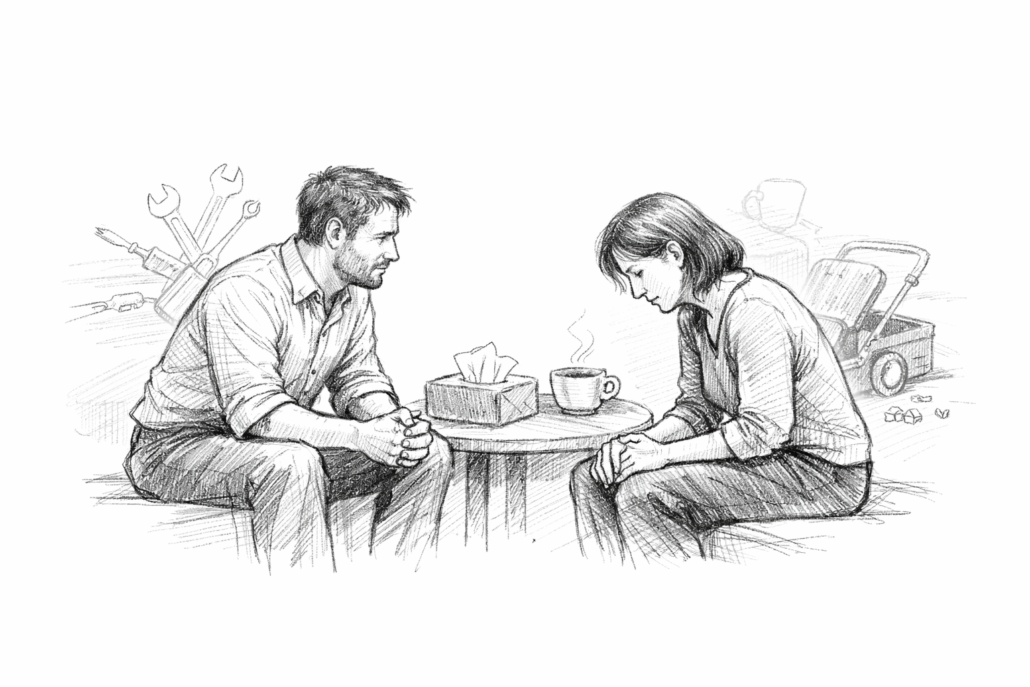
The Irony of Fixing: How Reductionism Can Break What It Tries to Repair
Working in the community sector, especially in mental health and suicide prevention, I am regularly reminded of Graham Long’s words, former CEO of The Wayside Chapel, who lived by the principle that “people are not problems to be solved, but people to be met.”
While it is common to hear people suggest “I’m broken”, they don’t often ‘break’ in predictable ways, and they cannot simply be repaired with tools, checklists, or quick fixes. Yet the temptation to “fix” people is strong, especially when we care deeply and want to lessen pain, distress, or risk.
I often think of my good mate Brian. He’s a talented tinkerer. If a machine isn’t working properly, Brian is the person you want by your side. He can analyse, adjust, and repair nearly anything mechanical. I once took him a second-hand lawnmower that barely sputtered. After a few hours with Brian, it ran like new.
But as much as I value Brian’s skill, I would never want him, or anyone, to try to “fix” me when I’m not quite right.
Because I am human, when I’m not feeling quite right, I need space to feel, to struggle, to learn, to grow. We need time to make sense of our own emotions, our own pain, our own stories. We are not objects to be tinkered with. We are beings to be understood, accompanied, and met.
In mental health and suicide prevention, this distinction matters deeply. People don’t reach out to us because they need fixing; they often do so because they’re seeking connection.
Pain Is Part of Being Human
In our sector, we hear constant messages about fixing, helping, preventing, and intervening. These all have their place. But so do pain, suffering, confusion and grief. These experiences are part of being human, part of how people develop resilience, meaning and identity.
As Harold Kushner writes:
“It may be that instead of giving us a friendly world that would never challenge us and therefore never make us strong, God gave us a world that would inevitably break our hearts, and compensated for that by planting in our souls the gift of resilience.”
(Kushner 2007, p.55)
When someone is amid pain, a parent grieving a child, a person facing a frightening diagnosis, someone carrying the weight of trauma, it can be hard to see suffering as any kind of “gift”. And yet, pain often shapes us in ways comfort never could.
Nonetheless, the urge to fix persists. We aim to remove pain because we don’t want people to suffer. However, sometimes, in our haste to fix, we may unintentionally silence, minimise, or override the very experiences people need to share.
The Trap of Reductionism
Another reason we try to fix people is because our systems are built on reductionism. We break problems into parts, identify causes, and apply solutions. This works well for machines, but it may not work so well for people.
Sidney Dekker describes this clearly:
“Newton and Descartes’ ideas have pretty much set the agenda for how we, in the West, think about science, about truth, about cause and effect… much of the thinking and work we do in safety and accident prevention is modelled after their ideas.”
(Dekker 2011, p.53)
Reductionism assumes that once we identify the broken part, we can fix it. But people are not just parts. They are stories, relationships, histories, cultures, emotions, and contexts. When we treat people as objects, we dehumanise them, even when our intentions are good.
Responding Differently
If we recognise that pain can build resilience and that reductionism dehumanises, then the question becomes: how do we respond differently?
- Notice the cues of reductionism – when we start talking about people as problems, cases or risks, we may already be slipping into objectifying them.
- Prioritise relationship over repair – compassion, empathy, listening and presence are far more powerful than solutions.
- Be conscious of binary thinking – pain is not “bad”; growth is not “good”. Life is rarely that simple.
- Honour the humanity in every interaction – in mental health and suicide prevention, our greatest tool is connection, not expertise.
Please Don’t Try to Fix Me
If you ever feel I’m not running quite right, I would welcome your time, your compassion, your presence and your conversation. But please don’t try to fix me.
I’m not a machine. Neither are the people we serve.
We are human beings, messy, complex, resilient, vulnerable, and capable of extraordinary growth when we are met, not repaired.
Author: Robert Sams Email: robert@dolphyn.com.au Web: www.dolphyn.com.au
References:
Dekker, S. (2011). Drift Into Failure: From Hunting Broken Parts to Understanding Complex Systems. Ashgate Publishing.
Kushner, H. S. (2007). Overcoming Life’s Disappointments. Anchor Books.


Leave a Reply
Want to join the discussion?Feel free to contribute!