
Humble Inquiry: A Way of Being, or a Method?
It was Graham Long, the former CEO of The Wayside Chapel, who used to say that:
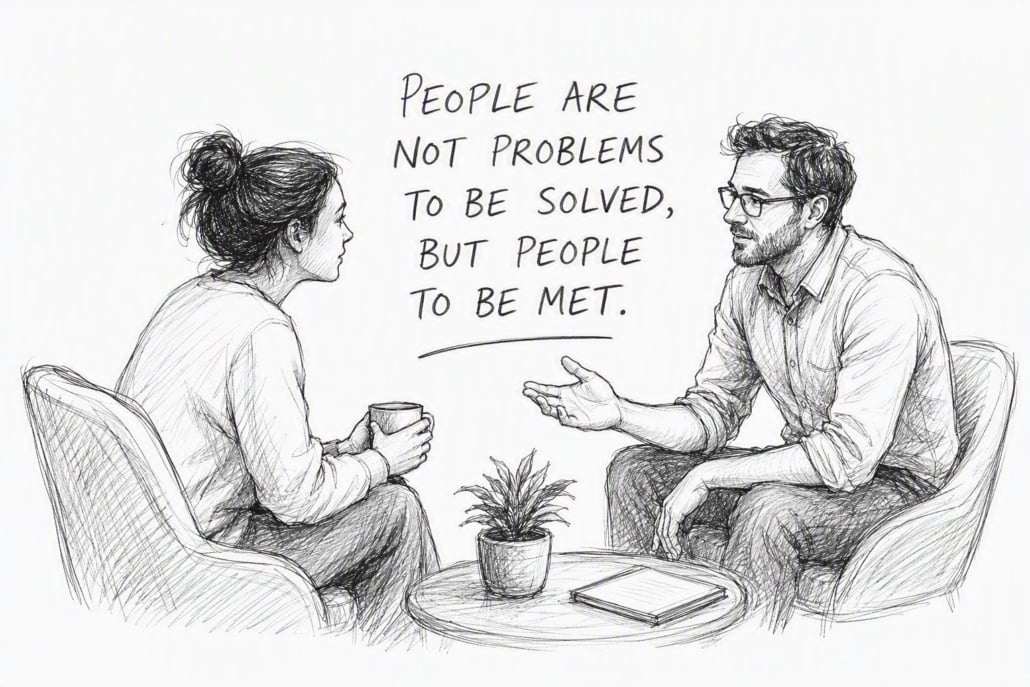
“People are not problems to be solved, but people to be met.”
I think about that line often, especially when working alongside front line leaders across the community sector and particularly when I reflect on my time at Lifeline, both supporting people in crisis and leading the teams who held those conversations every day.
There’s real energy right now around finding better ways (methods) to work with the people we serve: trauma-informed practice, strengths-based approaches, person-centred care. These shifts matter. Any movement away from fear, blame and punitive responses is a step in the right direction. But I’ve come to believe there’s a deeper question beneath all this good work: what does a new method actually achieve (no matter how good), if we haven’t first explored the worldview it rests on?
I want to explore that question through a conversation I had recently with someone I’ve worked alongside.
A Story About Humble Inquiry
This colleague had been reading Edgar Schein’s Humble Inquiry and was keen to bring it into how they led their team.
Schein describes humble inquiry as:
“…the fine art of drawing someone out, of asking questions to which you do not already know the answer, of building a relationship based on curiosity and interest in the other person.” (p.2)
On a first read, it sounds simple enough: ask more open questions, listen more, tell less, build the relationship. And it could be that simple, if we treat humble inquiry as a method, a new technique to add to the toolkit.
But I don’t think that’s what Schein is pointing us toward. What if humble inquiry wasn’t seen as a method, but instead as ‘a way of being’ that requires us to genuinely accept people, along with their ideas, their fallibilities and their failings.
Why This Is Harder Than It Sounds
The community sector is full of well-meaning systems built to fix things: intake forms, risk assessments, case plans, KPIs. There’s nothing wrong with any of these on their own. But when our underlying worldview is about fixing rather than ‘meeting‘, we drag humble inquiry into it. We turn it into a process. We look for a script. We measure how often we’re “doing” it.
That’s what a fixing worldview does to good ideas. It’s what has happened to plenty of well-intentioned frameworks before this one: they start as an invitation to be more human, and slowly become another box to tick.
So why is it so hard to simply be with people, rather than fix them?
Because making our reason for being about someone else is genuinely difficult. Fixing feels productive. It feels like progress. Meeting people, on the other hand, means sitting with the uncomfortable truth that someone might be hurting, and that there’s nothing we can do to make that go away right now. That doesn’t feel as good.
During my time at Lifeline, I saw this tension every day, not just in conversations with people seeking support, but in how I led the team. The pull toward fixing was, and is, strong. It takes real discipline to stay with someone’s story rather than rush toward a solution.
If you find yourself reaching for humble inquiry as a technique to fix someone, there’s a good chance your worldview is still leaning toward fixing.
I Tried Humble Inquiry, But It Wasn’t Working
My colleague told me about a recent, difficult conversation with someone they support. They said:
“I tried Humble Inquiry, but it just wasn’t working, so in the end I just had to tell them what to do. They weren’t getting it. Sometimes you have to revert to telling.”
There’s truth in that. There are times when telling, not asking, is genuinely what’s needed. And there are times when asking open questions can feel frustrating for someone who came looking for answers.
But humble inquiry isn’t a formula that tells us exactly when to ask and when to tell. That call has a lot to do with the worldview we’re standing in when we make it.
Schein calls humble inquiry:
“…the gentle art of asking instead of telling.”
He also points to what gets in the way:
“The main problem: a culture that values task accomplishment more than relationship building.” (p.55)
Our sector knows this tension well. Targets, throughput, case closures, they all matter. But when task accomplishment outranks relationship, humble inquiry doesn’t stand a chance, no matter how many training days we run on it.
Where I’ve Landed
I’ll admit that, for a long time, my approach to leadership and helping people was grounded in fixing. It took years of sitting with my own discomfort, including during my time at Lifeline, before I saw what that worldview was doing to the people around the teams I led and to me.
I’d like to think my worldview now is more humanising, more willing to sit with people rather than ‘solve them’. I’m not against frameworks, tools or checklists. We need them, and there are good people who build them well. It’s simply that when a fixing worldview is left unexamined, it turns even our best intentions, humble inquiry included, into another thing we do to people, rather than a way we choose to be with them.
Dolphyn… the Y that calls us into community.


Leave a Reply
Want to join the discussion?Feel free to contribute!