
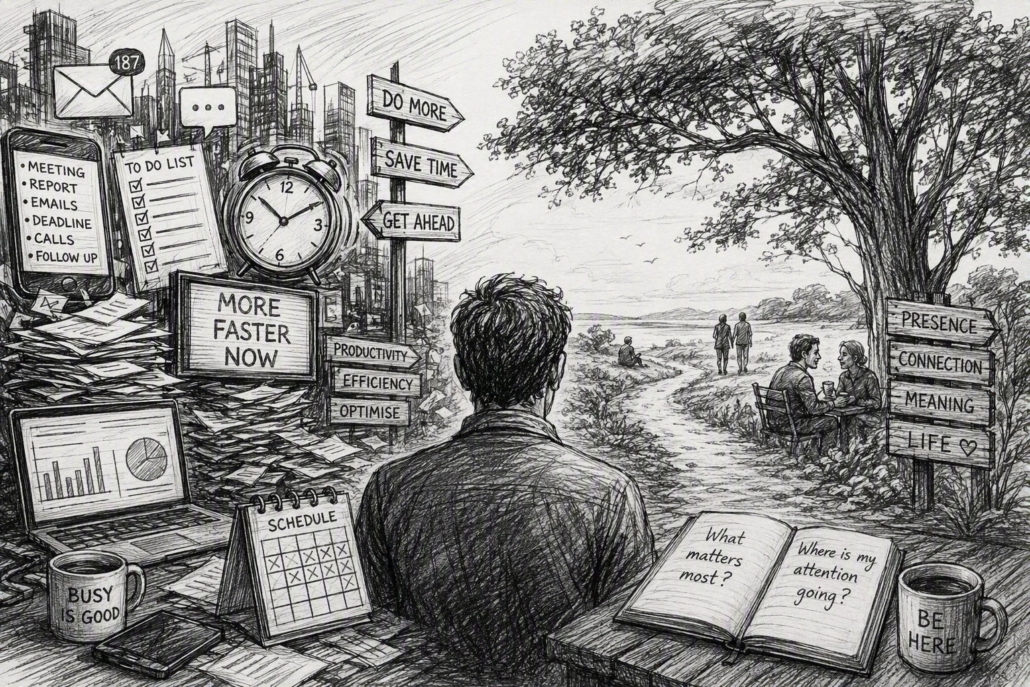
The Efficiency Paradox: Saving Time, but Missing Life
I find quiet satisfaction in getting things done. There is pleasure in watching a long list submit to ticks, bringing an inbox briefly under control, or completing a task and placing it behind me. Efficiency gives structure to the day. It offers the reassuring impression that movement is the same as progress. Perhaps you recognise this too?
There is nothing inherently wrong with efficiency. Life requires order. Work must be done, children collected, bills paid and meals prepared. Yet my own attraction to doing has taught me that completed tasks are not the only consequences of action. When I take something over because I want it finished, I may experience relief while another person experiences my help as control. What appears to me as competence may quietly diminish someone else’s autonomy, contribution or sense of worth. I explored this previously in Reflections of a ‘Doer’.
The difficult question is therefore not whether efficiency can serve us. Clearly, it can. The question is whether it continues to serve us, or whether we have begun to serve it.
Here lies the paradox. We save time and discover that we have no time. We multiply connections and find ourselves lonely. We expand our choices and lose the capacity to choose what matters. We become productive in ways that leave us strangely unproductive in the things we claim to value. We get more done and, in the doing, miss what is happening.
Could our efficient lives be working exactly as designed, yet failing the human beings who live within them?
Busy, but Where Are We Going?
Our modern problem is not simply that we are busy. Human beings have always worked, struggled and carried burdens. Something subtler is occurring. We inhabit systems that measure movement more easily than meaning. They record how quickly we respond, how many tasks we complete and how much we produce. They are less capable of recognising whether we were present, listened carefully, noticed another person or experienced something deeply human. Consequently, what can be measured gradually becomes what matters.
A conversation becomes an appointment, a friendship becomes a network and a walk becomes exercise. Rest is reinterpreted as recovery for further work. Reading becomes content consumption, and sleep becomes a performance metric. None of these descriptions is entirely false, which is what makes them seductive. The difficulty emerges when usefulness becomes the principal way we understand experience.
What happens when nothing is permitted simply to be?
In The Pathway of Loneliness, I distinguish between a genuine meeting and a gathering organised around production. A genuine meeting requires “presence, trust and risk” and needs no agenda, minutes or formal record. An efficient gathering assembles people to produce an outcome. Both may have a legitimate place, but perhaps productive gatherings have begun to consume human meetings.
This reveals a troubling incongruence. We say relationships matter, yet offer them only the fragments of time left after the important work is done. We say family matters, yet remain half-present while checking the device in our hands. We say health matters, yet organise our days in ways that leave us depleted. We praise community while pursuing independence, convenience and “the privatisation of the self” (Long, 2013).
This is not hypocrisy in a simple, moralising sense. We may sincerely believe the values we profess. The deeper problem is that we live according to another set of values embedded in our culture, technologies and institutions. Our diaries, devices and patterns of attention may disclose our practical commitments more honestly than our words.
Efficiency was once a means. Its promise was compelling: spend less time on what must be done so that more time becomes available for what matters. But what did we do with the time we saved? We filled it. We then acquired tools to manage what we had added. Those tools created further capacity, so we added more again. Faster communication did not necessarily reduce communication; it multiplied it. Labour-saving technologies did not always liberate us from labour. They often raised expectations about how much could be accomplished and how quickly we should respond.
Attention Is Not Merely a Personal Problem
In Stolen Focus, Johan Hari presents the contemporary loss of attention as something more complex than an individual failure of self-discipline. His central claim is that powerful external forces have acted upon our attention and that an adequate response requires both personal and social change.
This does not mean that individuals have no responsibility. It means responsibility cannot be reduced to blaming ourselves and trying harder. If our environments are designed to interrupt and accelerate us while converting attention into economic value, personal discipline alone cannot explain our predicament. Nor is another productivity technique likely to rescue us.
Indeed, the search for a perfect productivity method may be part of the problem. We respond to excessive efficiency by seeking a more efficient way to manage it. When overwhelmed, we download an app. When unable to focus, we watch a short video about focus. When lacking time, we schedule rest. When disconnected, we increase digital connection. Even our resistance is converted into another technique.
Jacques Ellul challenges the assumption that technological means remain neutral instruments under our control. In The Technological System, Ellul (1980) argues that technology is not simply an instrument people can use however they like because it possesses its own momentum and direction.
His point is not that every technique is evil or that we should retreat into an imagined past. Rather, technological thinking encourages us to interpret human difficulties as problems awaiting technical solutions. It teaches us to place our faith in method, measurement and control, even when these are poorly suited to the human reality before us.
Sometimes a technical solution is appropriate. But grief is not inefficient sadness. Friendship is not an information exchange. Love is not a successful transaction. Silence is not a communication failure, and a human being is not a faulty machine awaiting optimisation. When the means become the end, the tools intended to support life begin to define what life is permitted to contain.
Attention Is How We Spend a Life
We often speak about attention as though it were merely a cognitive resource. We ask how we might concentrate for longer, eliminate distractions and produce more in less time. These questions remain contained within the framework of efficiency. A more confronting question is: what is our attention for?
Attention is not simply something we use to complete life. Attention is how we participate in life. What we repeatedly attend to becomes, in a practical sense, what receives our presence.
Here our incongruence becomes difficult to ignore. I may say the person in front of me matters more than the message on my phone, yet my eyes repeatedly drop to the screen. I may claim to value contemplation, but after a few unoccupied seconds my hand reaches automatically for stimulation. I may desire a rich inner life while rarely remaining still long enough to encounter what is within me.
This is not offered as condemnation, because I recognise myself in each example. The empathetic question is not, “What is wrong with you?” It is, “Can we notice what is happening to us?” Can we recognise the distance between what we profess and what we practise without retreating into shame, blame or another self-improvement programme?
Efficiency also enters our inner lives by teaching us to understand ourselves as projects. We monitor our output, assess our performance and invest in constant self-improvement. We build personal brands, turn leisure into development and convert experience into material for public presentation. Even vulnerability can become content. The self is no longer simply lived; it is managed, measured and marketed.
When exhaustion arrives, we treat it as another personal failure. Perhaps we failed to prioritise, establish boundaries or maintain the correct morning routine. These explanations may contain some truth, but they can conceal a larger question: what kind of life requires so much private effort merely to remain human?
The Shortages Created by Abundance
The technological world promises abundance and, in many respects, delivers it. We have extraordinary access to information, communication, entertainment and convenience. It would be unwise and ungrateful to deny these genuine benefits. Yet abundance can create its own forms of scarcity.
Ellul observes that technological affluence is “counterbalanced by the creation of new ‘shortages’: of space, air, time, and the like”. The more information we possess, the harder it becomes to decide what deserves attention. The more ways we have to communicate, the more difficult sustained conversation may feel. The more entertainment we can access, the less capable we may become of inhabiting an unfilled moment.
We are not starving for content, but we may be starving for depth. We are not lacking connection, but may be lacking communion. We are not always short of time; we may simply be absent from the time we have.
Ellul’s warning is particularly relevant because he argues that the technological system transforms communication itself. Technology may support contact between people, but communion can be reduced to technological communication when mediation replaces encounter. The quantity of connection may increase while the experience of meeting another person becomes rarer.
The Courage to Be Inefficient
What might resistance look like?
Perhaps it does not begin with rejecting technology, abandoning responsibility or pretending modern life can be unwound. It may begin more humbly, with a refusal to judge every moment according to its output.
This could mean having a conversation that goes nowhere useful, sitting with someone without trying to solve them, reading slowly enough to be changed, walking without measuring the distance, or listening without preparing a response. It might involve eating without simultaneously consuming information and allowing boredom to remain long enough for something unexpected to emerge.
Such practices invite us to regard attention as hospitality. When we attend to someone, we make room for that person to exist beyond their usefulness to us. We suspend, however briefly, the demand that the encounter produce something.
A real meeting is costly, which is why the cheaper substitute is attractive. Yet the cost of cheap connection may be loneliness. An encounter organised exclusively around utility may produce an outcome without creating a genuine “us”. Its apparent efficiency may be exactly what prevents it from becoming fully human.
There is a danger, however, in transforming this argument into another efficient programme for living less efficiently. Five steps to presence, seven habits of unhurried people or a thirty-day attention challenge would be too neat. The point is not to master life through a superior method. It is to recover our freedom to ask what our methods are doing to us.
The question is not whether efficiency is good or bad. It is whether efficiency has remained in its proper place. Does it serve life by creating room for love, reflection, play, relationship and genuine rest? Or has it become an unconscious object of devotion, requiring every activity to justify itself by producing something else?
We know how to move faster, but not always why we are going. We know how to remain connected, but not necessarily how to meet. We know how to fill time, but not how to inhabit it. We know how to make a living, yet may be losing touch with how to live.
What If We Are Not Behind?
Perhaps you are not behind. Perhaps the feeling of being behind is one of the ways an endless system maintains its hold upon us. There will always be another message, task, improvement, purchase, article or demand. There is no finishing line at which the modern person is finally permitted to say, “Now I have done enough. Now I may live.”
Living must happen before the list is complete. It must happen among unfinished tasks, uncertain relationships and unremarkable moments that cannot be converted into achievements. This requires something more confronting than time management. It asks us to relinquish the comforting illusion that a well-managed life is necessarily a well-lived life.
It also asks whether busyness protects us from questions we would rather not hear. Who am I when I am not producing? What remains when I stop performing? Which people receive what is left of me rather than the best of me? What values does my diary reveal? What am I postponing until life becomes less busy, and what if life never does?
I do not ask these questions from a place of mastery. I remain implicated in them, attracted to the satisfaction of accomplishment and the reassuring rhythm of doing. Yet perhaps we can pause together without turning even the pause into a technique.
Life is not waiting at the end of our efficiency. It is occurring now, quietly and inconveniently, without an agenda. While we have been busy saving time, there is every chance that life has been trying to get our attention.
References
Ellul, J. (1980). The technological system (J. Neugroschel, Trans.). Continuum. (Original work published 1977).
Hari, J. (n.d.). Stolen focus: Why you can’t pay attention and how to think deeply again. Official Stolen Focus website.
Long, G. (2013). Love over hate: Finding life by the wayside. Slattery Media Group.


Leave a Reply
Want to join the discussion?Feel free to contribute!